A cosmetic packaging sample tested for appearance, dimensions, structure, stability, cap fit, and opening experience determines readiness for mass production. Skipping these checks forces costly mold revisions, delays shipments, and damages brand reputation. A structured pre-production sample review identifies defects early.
Manufacturers must verify every element before bulk production. Color consistency, surface finish, and printing adhesion require calibrated inspection. Wall thickness, bottom stability, and barrier properties demand rigorous testing. Cap torque and seal integrity confirm daily usability.
An approved pre-production sample eliminates uncertainty. Cosmetic packaging solutions from experienced suppliers include comprehensive quality inspection. Premium cosmetic glass packaging warrants particular scrutiny. Thorough evaluation before bulk production protects investment and ensures flawless consumer experience.
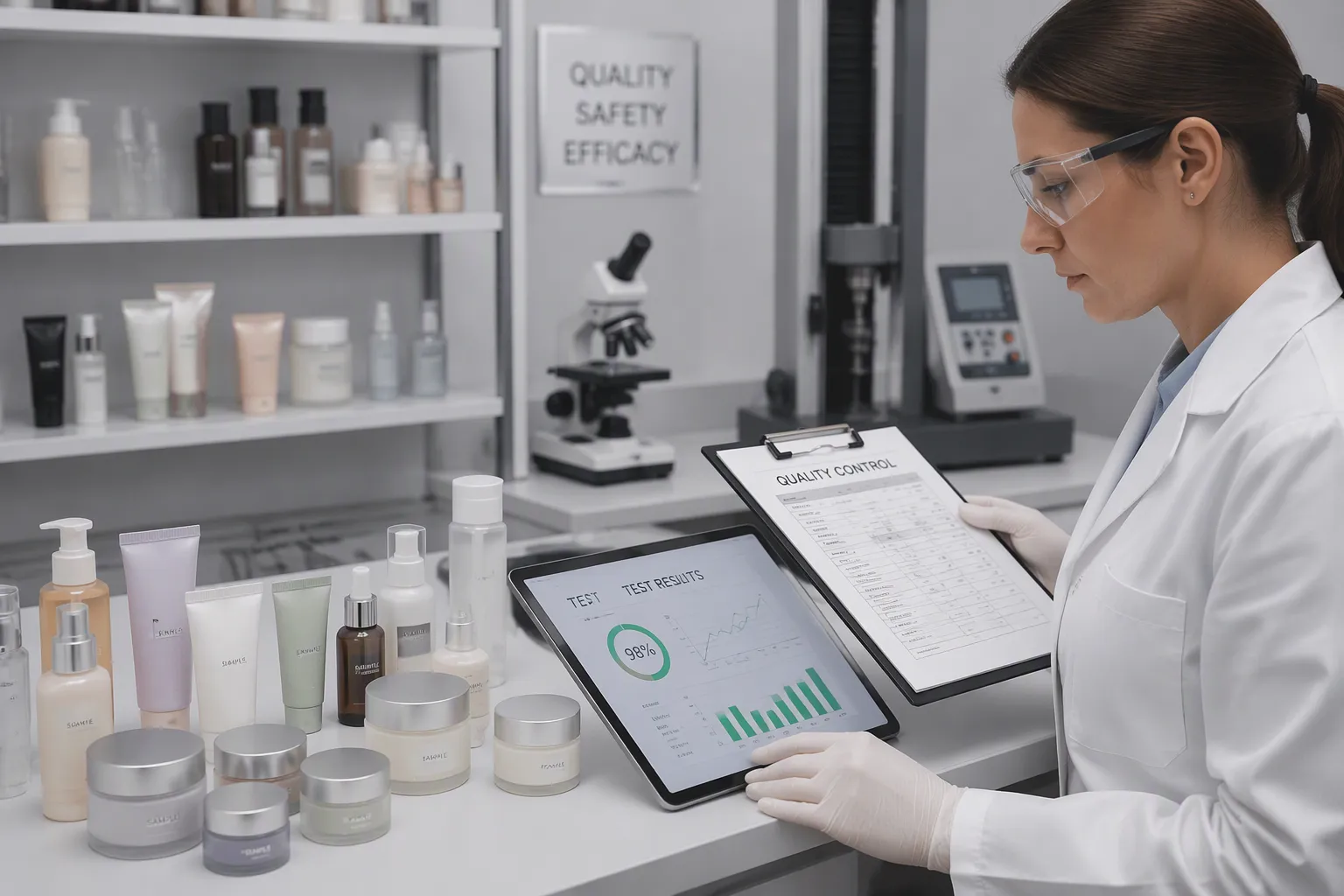
Test the sample's appearance and dimensions to catch defects early.
Check structure and stability to prevent leaks and breakage.
Evaluate cap fit and opening to ensure daily usability.
Assess user experience and formula compatibility for quality.
Detect issues early to save money and protect your brand.
Appearance and dimension checks form the first visual gate for any cosmetic packaging sample tested before mass production. Inspectors compare the physical sample against approved drawings, color standards, and decoration requirements. This step catches visible defects early and prevents downstream failures.
Inspectors measure critical dimensions with calibrated digital calipers. They verify the neck finish outer diameter and inner diameter against the closure supplier's stated tolerance. They also check dip tube length against the container's internal depth. The tube must reach the bottom without bending or leaving excessive dead volume. Fill opening diameter must fit standard filling equipment nozzles without spillage risk.
Every measured dimension is cross-referenced against the supplier's technical drawing. Any deviation exceeding the stated tolerance triggers corrective action before production approval. A formal specification correction request once required all glass pipettes to meet the inner neck finish diameter within a tolerance of plus or minus 0.1 mm. The manufacturer confirmed the correction and provided new samples for re-verification.
Color consistency inspection and printing adhesion inspection belong here as well. ASTM D3359 and ISO 2409 guide tape and cross-cut assessment, though neither measures absolute adhesion strength. ISO 3664:2025 specifies viewing conditions for critical color evaluation. A physical sample approved under consistent lighting defines the production standard.
Proportion inspection confirms the sample matches the intended silhouette. Inspectors check wall thickness, corner radii, and overall symmetry. Surface finish inspection evaluates gloss, matte, or textured effects against the approved reference.
Printing adhesion inspection uses tape pull, dry rub, and wet rub methods. Each test challenges different failure modes. Tape pull reveals gross attachment issues. Dry rub exposes wear and scuffing. Wet rub simulates chemical attack combined with wiping. Lisson uses calibrated color and print checks on every sample. These inspections confirm that cosmetic packaging solutions meet brand specifications before bulk production begins.
Structure and stability testing prevents deformation, leakage, and collapse. A cosmetic packaging sample tested for these properties confirms the package will survive filling, transport, and daily use. This stage of cosmetic packaging quality inspection moves beyond appearance into functional performance.
Wall thickness variation causes weak points. Inspectors measure wall thickness at multiple points around the container. Thin sections rupture under pressure. Thick sections waste material and add weight.
Bottom stability determines whether a bottle tips during automated filling or consumer use. For thick-bottomed square glass perfume bottles, structural engineers apply finite element analysis alongside physical drop testing to assess how impact energy is distributed. The concentrated mass at the base substantially lowers the center of gravity, which inherently prevents tipping during automated filling. However, this design also changes how kinetic energy propagates through the container upon impact. To prevent structural failure, manufacturers conduct rigorous thermal shock and drop impact tests under standardized quality assurance protocols, ensuring the heavy base does not impose excessive stress on the thinner vertical sidewalls. Thermal shock testing subjects the container to a sudden temperature variation transfer with a 0.0% fracture rate requirement. Drop impact testing uses a 1.2 m free-fall onto a rigid steel plate, requiring survival across three axis orientations. Internal pressure testing applies hydrostatic progressive pressure, demanding greater than 0.8 MPa resistance. These checks confirm bottle stability and structural integrity.
Multi-part cosmetic packaging demands precise alignment. Premium tolerance standards hold cap and closure fit to plus or minus 0.01 to 0.05 mm with a definitive click or smooth magnetic snap. Budget standards allow plus or minus 0.1 mm or wider with loose wobble. Seam alignment on multi-part assemblies must show no visible step or offset. Lipstick mechanisms require controlled glide with no wobble at full extension.
Barrier properties protect the formula. Air permeation testing measures gas transmission through the package wall. Package internal air volume testing confirms the headspace matches design. Package entity testing verifies overall construction. Glass bottle impact testing and packaging pressure testing simulate transport hazards. A burst test pressurizes the package until failure, directly measuring maximum internal pressure resistance. A creep test maintains constant pressure for a set time, evaluating deformation under sustained load. Creep-to-failure testing determines time-to-failure under constant load. Humidity affects performance: at 98% relative humidity versus 50%, bursting strength decreases by 52.8%. Lisson runs these barrier and impact checks on every cosmetic packaging prototype. These inspections confirm the physical prototype is structurally sound before bulk production inspection begins.

Cap fit and opening tests confirm daily usability for any cosmetic packaging prototype. These checks simulate real consumer interaction, revealing defects that static inspection cannot detect. A cap that fits perfectly in the lab may bind, wobble, or leak after repeated use. Thorough evaluation before bulk production prevents these failures from reaching store shelves.
Cap torque testing measures the force required to open and close a container. Inspectors use calibrated torque meters to verify that caps meet specified tightness ranges. A cap that requires excessive force frustrates consumers. A cap that opens too easily risks leakage during transport. Both extremes indicate poor component fit between the closure and the container neck.
Interference checks examine how the cap interacts with the container threads. Inspectors look for cross-threading, stripping, or uneven engagement. Magnetic closure boxes use hidden magnets in the flap or lid area to create a smooth closing experience. In cosmetic packaging, this structure often appears in gift boxes, launch kits, skincare sets, and premium beauty collections where the opening feel needs to support the product's brand position. Premium cosmetic glass packaging demands particularly precise cap fit and opening behavior, as glass tolerances vary more than plastic.
Mini jar: Formula exposure, opening and closing, applicator, seal, residual access and label space.
This evaluation framework applies to small-format containers where every interaction matters. Assembled products like lipstick require fit, movement, closure, appearance, and product protection checks. The mechanism must glide smoothly without wobble at full extension.
|
Packaging format / review stage |
How opening and closing experience is measured |
|---|---|
|
Sachet or pouch |
Assessed as part of the fill/seal route, laminate selection, opening experience, dose, artwork, and outer display format |
|
Sample matching |
Evaluated through opening and closing behavior |
|
Dispensing and handling review |
Checked for opening, reclosure, dose, priming, residue, orientation, and realistic repeated use |
Dispensing performance testing verifies that pumps, droppers, and sprayers deliver the correct dose. Inspectors check priming behavior, residue after use, and orientation sensitivity. Re-closing tests confirm that caps maintain seal integrity after multiple open-close cycles.
Seal integrity testing employs several standardized methods. ASTM D3078 uses bubble emission to detect leaks in flexible barrier materials. ASTM F2338 applies vacuum decay for non-porous packaging. ASTM F2054 performs burst testing using internal air pressurization. ASTM F2227 evaluates lotion pump performance and dispensing consistency. ASTM D6653 simulates high-altitude pressure changes. ASTM D4169 tests distribution environments including vibration and shock.
|
Package Type |
Sealing System Components to Test |
|---|---|
|
Bottle |
Neck + closure + liner |
|
Airless bottle |
Bottle + pump engine + piston + actuator |
|
Lip gloss |
Bottle + neck + wiper + rod + cap |
|
Dropper |
Bottle + neck + bulb + collar + pipette |
Testing only one component is insufficient; the entire sealing system must be evaluated. Weight loss monitoring detects evaporation and permeation of volatile components. Imperfect sealing allows fragrance or solvent escape through microscopic gaps.
Inspect all sealing interfaces: threads, snap fits, liners, gaskets, crimp areas, heat seals, tube end seals, pump interfaces, and airless bottle bases.
Apply a combination of test methods appropriate to the package type: inverted storage, vacuum or pressure methods, dye or tracer methods, torque checks, and transit simulation.
Match the test method to the package construction, as rigid glass bottles, flexible tubes, airless piston bottles, and mascara packs fail differently.
For weight loss monitoring, standardize the weighing procedure, account for balance resolution, fill variation, product residue, and solvent volatility, then calculate change against the baseline for the same unit.
A cosmetic packaging sample tested for cap fit and opening experience provides confidence before bulk production. Lisson incorporates these checks into every pre-production sample review. The approved pre-production sample then serves as the reference standard for bulk production inspection. Cosmetic packaging solutions from experienced suppliers include comprehensive cap fit and opening verification. This inspection stage protects brand reputation and consumer satisfaction.
User experience testing examines how a consumer interacts with a cosmetic packaging prototype in real conditions. This stage of prototype evaluation moves beyond laboratory measurements into practical usability. A package may pass every dimensional check yet still feel awkward, dispense poorly, or fail to convey premium quality. Physical prototype evaluation provides the only reliable way to assess these subjective factors before committing to mass production.
Physical samples allow evaluators to assess properties that digital renderings cannot represent. Size, weight, texture, and hand feel require direct manipulation. The finish of a surface and the pump or closure mechanism carry significant consumer impact. These elements determine whether a product feels premium or cheap.
Evaluators measure several physical properties during this inspection:
Mass and balance – Heft registers first in the hand. Mass concentrated low toward the palm reads as planted and substantial. Mass distributed high reads as cheap and unstable.
Ra roughness – This quantifies surface texture. Smoother finishes typically signal higher quality.
Gloss at 60 degrees – This measures visual finish consistency against the approved reference.
Gap dimensions in millimeters – Tight gaps and flush tolerances between components signal precision.
Sound frequency on closure – A high ringing click above 4 kHz reads as flimsy. A short low thunk between 1–2 kHz reads as solid.
Force curves – These track opening, closing, and dispensing resistance throughout the full range of motion.
Blind tests – Participants compare the prototype against rival products and guess the price point.
Evaluators also remove cheap signals such as sink marks and sharp parting lines. Sound tuning uses dome geometry, damping material, wall thickness, and internal ribbing. Each adjustment targets a specific frequency and decay time. This level of prototype testing ensures the final product communicates quality through every sense.
Cap fit and opening behavior remain critical consumer-experience factors. A cap that is too loose, difficult to open, misaligned, or uncomfortable directly reduces perceived quality. Even small unwanted movement between components affects the perceived quality of premium cosmetic glass packaging. The approved pre-production sample must demonstrate flawless interaction before bulk production begins.
Package compatibility testing verifies that the container and the formula work together without degradation. This inspection stage examines physical changes, formula stability, leakage, weight loss, seal integrity, dispensing, and decoration at planned intervals. The testing confirms that the packaging does not compromise product quality or safety.
During stability and compatibility testing, key parameters monitored include physical and chemical properties such as pH and viscosity, as well as organoleptic properties like color, odor, and texture. Microbiological stability and packaging interaction are also evaluated. Packaging materials may interact with the product, leading to leaching of substances or changes in product composition, which is why compatibility testing is essential to ensure product and packaging work together without compromising quality and safety.
Several physical changes indicate package–formula incompatibility during this inspection:
|
Physical Change |
How It Indicates Package–Formula Incompatibility |
|---|---|
|
Color change |
Pigments or dyes react with metal ions leached from the container. Oxidation-sensitive actives such as vitamin C degrade faster when trace metals catalyze reactions. Colorants migrate into plastics, staining the container and depleting the formula. |
|
Scent change |
Fragrance molecules absorb into plastic walls, stripping scent from the formula. Plasticizers pull from the container into the product, adding chemical off-notes. |
|
Viscosity change |
Emulsifiers and thickeners disrupt when pH shifts from leaching. A pourable lotion can turn grainy or separate in the wrong container. |
|
Preservative failure |
Preservatives bind to plastic surfaces instead of remaining in the formula. Effective concentration drops, leaving the product vulnerable to microbial contamination. |
|
Physical failure |
Solvents and essential oils crack, cloud, or stress-fracture specific plastics. Hairline cracks can develop by week eight. |
Manufacturers follow a structured inspection schedule to catch these failures early:
Day 0 – Record baseline measurements: weight, pH, visual grade, dose weight, torque, and photos.
Week 2 – Perform the first compatibility check. If severe failure occurs, such as stress cracks or major weight loss, stop testing and consider alternative materials.
Month 1 – Conduct a full panel: weight, pH, visual inspection, seal integrity, and dose.
Month 2 – Repeat the full panel and monitor for gradual changes.
Month 3 – Use as an interim decision point for water-based and oil-based serums.
Month 6 – Perform final evaluation for creams and emulsions. Add tests such as FTIR or DSC if subtle migration is suspected.
GMP guidance also requires testing fresh and retained samples for microbial preservation adequacy. This inspection confirms that the formula remains protected throughout the product's shelf life. Cosmetic packaging solutions from experienced suppliers include comprehensive compatibility protocols. The pre-production sample must pass every stage of this inspection before bulk production approval. Thorough prototype evaluation protects the brand from costly recalls and consumer complaints.
Prototype testing identifies problems early and prevents costly changes. A single overlooked defect in a cosmetic packaging prototype can trigger mold revisions, delayed launches, and damaged brand equity. The pre-production sample serves as the final gate before bulk production. Experienced suppliers treat this stage as a formal pre-production quality control step, not a casual visual check. They review a structured pre-production checklist with clients, confirming every test category before granting final production approval.
Early detection saves substantial expense. A defect found during prototype evaluation costs only the sample run. The same defect discovered during bulk production inspection forces rework, sorting, or complete rejection of thousands of units. The cost difference is dramatic. A dimensional deviation caught at the pre-production sample stage requires a simple mold adjustment. The same deviation discovered after filling and labeling requires scrapping finished goods.
Quality control records protect both parties. Without documented evidence, disputes arise over what was approved and when. A comprehensive record system captures change control, testing and release, nonconformance and CAPA, traceability, audit control, and continuity. Each category carries specific risks if missing. Silent substitutions occur without change control. Shipments proceed before evidence review without testing and release records. Sorting happens without authorization when nonconformance documentation is absent. Traceability gaps prevent isolating affected stock after a complaint. These records form the backbone of responsible sample approval.
A practical pre-production checklist covers appearance, dimensions, structure, stability, cap fit, opening and closing, user experience, compatibility, and barrier tests. Each category contains specific checks that inspectors must verify against the approved physical prototype.
|
Test Category |
Specific Checks |
|---|---|
|
Appearance |
Overall proportions; shape and visual balance; surface appearance; design consistency |
|
Dimensions |
Height and diameter; capacity; component dimensions; critical tolerances |
|
Structure |
Wall thickness; bottom stability; corners and edges; component alignment |
|
Closure (Cap Fit) |
Cap fit; opening and closing; movement; component interference |
|
User Experience |
Hand feel; ease of operation; dispensing experience; overall perceived quality |
Compatibility testing examines chemical interaction with the actual formula, environmental stress cracking, swelling, permeation, and interaction with seals and gaskets. Barrier properties vary by material. Glass offers excellent general barrier performance. Plastic performance depends on resin selection. Stability checks include bottom stability, paneling under vacuum, hot-fill distortion, and thermal-shock risk. Distribution testing follows ISTA 3A for parcel shipments and ISO 2248 for free-fall drop testing.
Experienced suppliers avoid using the word "approved" without defined scope. They may approve a dieline and product fit while leaving production color open. The approved physical pre-production sample becomes the production inspection reference. Suppliers and clients agree on measurable criteria: dimensions, color reference, finish position, adhesion, packing count, and acceptable defect limits. During bulk production quality control, the quality team compares output against the same approved reference. This approach closes the loop from design intent to repeatable check.
Lisson reviews this pre-production checklist with every client before approving a pre-production sample. The company applies calibrated inspection methods across premium cosmetic glass packaging and other formats. Cosmetic packaging solutions from experienced suppliers include this structured review process. The approved pre-production sample then guides bulk production inspection. This thorough prototype approval process confirms the cosmetic packaging sample tested meets every requirement before mass production begins.
Prototype approval demands far more than a visual check. It requires full evaluation of appearance, dimensions, structure, stability, cap fit, opening and closing, user experience, compatibility, and barrier properties. Comprehensive testing is the only way to confirm a cosmetic packaging sample is ready for mass production.
|
Acceptance Area |
Criteria Before Mass Production |
|---|---|
|
Filling and dispensing |
Fill weight, torque, seal results, leak inspection, code legibility |
|
Delivery system |
Actuation force, spray rate, priming, leakage, usable doses |
|
Qualification packet |
Bill of materials, drawings, stability plan, change control |
|
Sampling |
Beginning, middle, and end of run; deviation assessment |
Adopt a structured checklist, and partner with experienced suppliers like Lisson. This disciplined inspection approach supports reliable mass production and protects every brand.
A pre-production sample requires appearance, dimension, structure, stability, cap fit, opening and closing, user experience, compatibility, and barrier testing. Each inspection category confirms the package meets design specifications. Suppliers compare results against the approved physical reference before granting production approval.
Cap torque testing measures opening and closing force with calibrated meters. Inspectors check for cross-threading, stripping, and uneven engagement. Seal integrity inspection uses methods like ASTM D3078 and ASTM F2338. These checks confirm the closure performs reliably through repeated consumer use.
Compatibility testing monitors physical changes, formula stability, leakage, weight loss, seal integrity, dispensing, and decoration at planned intervals. Inspectors record baseline measurements on Day 0 and repeat full panel inspection at Week 2, Month 1, Month 2, Month 3, and Month 6. This schedule catches degradation early.
A defect found during prototype evaluation costs only the sample run. The same defect discovered during bulk production inspection forces rework, sorting, or rejection of thousands of units. Early inspection prevents mold revisions, delayed launches, and damaged brand equity.
ASTM D3078 uses bubble emission for flexible barriers. ASTM F2338 applies vacuum decay for non-porous packaging. ASTM F2054 performs burst testing with internal air pressurization. ASTM D4169 tests distribution environments. Each standard targets a specific failure mode during inspection.
WhatsApp : +86 15099958531
E-mail : lissontube@gzlisson.com
Telefono : +0086 15099958531